Ejercicios de continuidad de funciones
Sea la función f(x) defida por:
\(\displaystyle f(x)= \left\{
\begin{array}{c}
\frac{|x-3|}{x-3}\;, \; \forall x\neq 3 \\
\\
0 \;, \; \textrm{para }x = 3\\
\end{array}
\right.\)
Determinar su gráfica y calcular:
\(\displaystyle\lim_{x\rightarrow 3^+}f(x)\quad ; \quad \lim_{x\rightarrow
3^-}f(x)\quad ; \quad \lim_{x\rightarrow 3}f(x)\)
Respuesta al ejercicio 20
Teniendo en cuenta la función :
\(\displaystyle f(x)= \left\{
\begin{array}{c}
\frac{|x-3|}{x-3}\;, \; \forall x\neq 3 \\
\\
0 \;, \; \textrm{para }x = 3\\
\end{array}
\right.\)
Se tiene:
\( \displaystyle \begin{array}{l}
\forall x > 3 \Rightarrow f(x) = \frac{x-3}{x-3}= +1 \\
\\
\forall x < 3 \Rightarrow f(x) = - \frac{x-3}{x-3}= -1
\end{array}\)
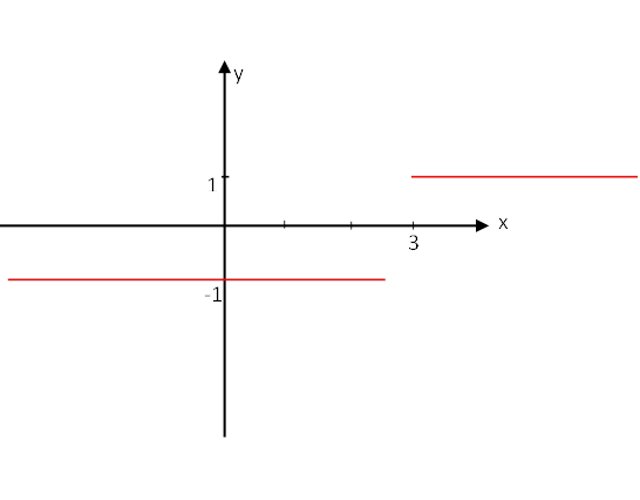
Por lo tanto, la gráfica de la función será:
Para calcular el primer límite, según la gráfica
vemos que se tiene:
\(\displaystyle \lim_{x\rightarrow 3^+} f(x) = 1 \)
Lo comprobamos:
\(
\forall \varepsilon > 0 \quad \exists \; \alpha > 0 / \forall x \in (3, 3+\alpha) \Rightarrow |f(x) - 1|< \varepsilon\)
Por ser \(x > 3 \Rightarrow f(x) = 1\), luego tenemos:
\( |f(x) - 1| = |1 - 1| = 0 < \varepsilon \quad ; \quad \forall
\alpha \)
Para el segundo límite, según la grafica vemos
que se tiene:
\( \displaystyle \lim_{x\rightarrow 3^-} f(x) = -1 \)
Por lo tanto se ha de cumplir:
\( \forall \varepsilon > 0 \quad \exists \; \alpha > 0 / \forall
x \in (3+\alpha, 3) \Rightarrow |f(x) -(-1)|< \varepsilon\)
Tenemos:
\( \forall x < 3\quad , \quad f(x) = -1 \Rightarrow |f(x)-
(-1)| = |-1 - (-1)| = 0 <\varepsilon \quad ; \quad \forall
\alpha \)
De todo resulta:
\(\displaystyle \lim_{x\rightarrow 3^+} f(x) = 1 \neq \lim_{x\rightarrow
3^-} f(x) = -1 \)
y no existe el límite de f(x) cuando x tiende a 3, porque
son distintos el límite por la izquierda y el límite
por la derecha. Por lo tanto, em el punto x = 3, la función
es discontínua ; representando una discontinuidad finita
de primera especie, con un salto igual a 2.